

AUM Advisors
米国上場への3つの道
米国上場への3つの道
IPO, De-SPAC, or Direct Listing? An Evidence-Based Decision Framework for Management Teams and Boards of Overseas Companies
一目でわかる
Short answer: International companies can list in the U.S. through a traditional IPO, a merger with a SPAC (de-SPAC), or a direct listing. An IPO suits companies that need primary capital and can absorb market-timing risk. A de-SPAC offers price and timing certainty, but works only when the deal attracts $100 million or more of institutional capital at close. A direct listing minimizes dilution and fees but raises little or no new money.
- 2025年の米国における新規株式公開(IPO)の57%は、米国外に本社を置く企業によるものでした。
- 2026年上半期に発表されたSPACの合併対象企業の43%は海外企業だった。
- De-SPACs that raised $100 million or more of institutional capital at close (straight equity PIPE plus retained trust) posted a median return of +17.2% over two years; deals below that line posted −90.3%.
上場経路別の流動性およびアナリストによるカバレッジ、2025年米国上場クラス(中央値;2026年9月10日までの20日間平均)
| 測定 | 大規模な新規株式公開(IPO) | 小規模な新規株式公開(IPO) | デ・SPAC | 直接上場 |
|---|---|---|---|---|
| 1日あたりの取引高の中央値(ドル) | $24.22M | $1.04M | $0.89M | $0.41M |
| セルサイドの平均アクティブ・レーティング | 9.5 | 1.2 | 1.4 | 1.0 |
| アナリストによるカバレッジがない銘柄を共有する | — | 77% | 65% | — |
出典:AUM Advisors の分析。
引用方法: AUM Advisors 、「米国上場への3つの道」、2026年9月、https://aumadvisors.com/us-listing。データは、出典を明記し、本ページへのリンクを記載した上で引用可能です。メディアからの問い合わせ:info@aumadvisors.com。
3
米国上場へのさまざまな道――それぞれ異なるタイプの企業に適したもの
57%
2025年に米国で実施された新規株式公開(IPO)のうち、米国以外を本社とする企業が占める割合
1,100+
Transactions behind the evidence — every IPO,
de-SPAC, and direct listing since 2024, plus 699 de-SPACs since 2010
書式付きの資料をご希望ですか? PDFをダウンロード(英語) · 日本語版PDF
このガイドの対象読者
本ガイドは、米国以外で事業を展開し、米国での上場を検討している企業の経営陣や取締役会を対象としており、ピッチミーティングが始まる前に、上場を実現するための3つの方法について、明確かつ事実に基づいた理解を深めたいと考えている方々に向けて作成されています。
If your company is weighing a US listing, you will hear from underwriters that the traditional IPO is the gold standard. You will hear from SPAC sponsors that a merger is faster and more certain. You may hear from advisors that a direct listing minimizes the fees and dilution associated with either an IPO or a de-SPAC.
これらの主張はいずれも、ある企業にとっては真実であり、別の企業にとっては大きな負担となるものです。そして、どんなに有能なアドバイザーであっても、自分が販売する商品について説明しているに過ぎないのです。
ここで私たちが目指すのは、それとは異なることです。つまり、それぞれの道筋がどのように機能するか、それぞれにどれほどのコストがかかるか、それぞれが何をもたらすか、そして――2024年以降の米国におけるすべての上場事例の完全な記録を用いて――それぞれの道を選んだ企業に実際に何が起きたのかを説明することです。
米国の資本市場 は、依然として世界で最も規模が大きく、流動性が高く、柔軟性に富んでおり、適格な海外発行体に対して引き続き門戸を開いています。2025年の米国における新規株式公開(IPO)の57%は海外に本社を置く企業によるものであり、2026年上半期に発表されたSPACの合併対象企業の43%は海外企業です。ここに確かなビジネスチャンスがあります。しかし、米国市場へのさまざまな参入経路には、それぞれ違いがあることも事実です。
A note on our evidence. Everything quantitative in this guide traces to a named source: Renaissance Capital’s IPO datasets, SPAC Insider’s de-SPAC universe, Jay Ritter’s academic data, SEC filings, and exchange trading records, supplemented by our own published research — The Five Disciplines of De-SPAC Success (699 completed de-SPACs since 2010), The De-SPAC Scorecard (quarterly), and Everything Is Negotiable (every H1 2026 merger agreement). Our goal is to provide unvarnished data and a framework for each company to weigh its options.
企業が米国で上場する理由――3つの目的
上場に関するあらゆる決定は、最終的には以下の3つの要素の組み合わせを購入することになります:
一次資本— 成長資金として貸借対照表に計上される新たな資金。
流動性— 創業者、従業員、初期投資家が時間をかけて持分を現金化できるだけでなく、新規投資家がポジションを構築できる取引市場。
信頼性の確立と評判— 継続的に公開される価格、世界的に認知された取引所への上場、そしてそれによって顧客、ビジネスパートナー、融資先、買収対象企業、将来の投資家から得られる信頼。
この3つの目標こそが、本ガイドがあらゆる投資戦略を評価する際の基準です。多くの論評――率直に言えば、私たち自身の研究を含め、ほとんどの研究もそうですが――は、測定しやすい最初の指標、すなわち株価のみを評価対象としています。
株価は重要であり、我々は取引データに基づく証拠を提示しています。しかし、高値で取引されているにもかかわらず、実質的な出来高が決して伸びない上場企業は、流動性を確保できていません。アナリストによるカバレッジがない上場企業は、市場からの評価を得られていません。また、追加公募を支えることができない上場企業は、持続的な資金調達手段を確保できていません。
そこで本ガイドでは、通常は並べて比較されることの少ない2つの指標、すなわち各進路の最近のコホートにおける取引流動性とリサーチカバレッジを追加しています。
米国の「資本市場 」のもう1つの利点は、各経路のコストをどのように評価すべきかという点に変化をもたらすため、冒頭で強調しておく価値がある。それは、米国市場特有の柔軟なフォローオン・ファイナンス制度である。
一度上場し、実績を積んだ米国上場企業は、シェルフ登録、アット・ザ・マーケット(ATM)プログラム、登録済み直接販売、転換社債などを通じて追加資金を調達することができます。多くの場合、新たなロードショーの有無にかかわらず、わずかなコストで、わずか数日で調達が可能です。初回上場が資金調達の最終段階というわけではありません。成長企業のほとんどにとって、それは数ある資金調達の第一歩に過ぎないのです。 2回目、3回目の資金調達に向けて企業を有利な立場に置くような道筋は、投資家が初めて株式に投資する際に、意味のある譲歩を行う価値があると言えるでしょう。
「3つの道」の概要
結果を比較する前に、各プロセスで何が起きているのかを正確に把握しておくと役立ちます。簡単に言えば:
The traditional IPO — a marketed sale of new shares
The company files a registration statement (Form S-1, or F-1 for foreign private issuers) with the SEC and engages investment banks as underwriters. After SEC review, management conducts a roadshow — typically one to two weeks of meetings with institutional investors — while the underwriters "build the book": collecting orders at indicated prices. The night before trading, company and underwriters set the offer price; the underwriters buy the shares and resell them to the investors they select, standing behind the deal with their own capital and their legal liability for the prospectus. On the first trading day, the underwriters can support the price using an over-allotment ("greenshoe") of extra shares. The company receives the offering proceeds, less an underwriting discount of roughly 5–7% on small- to mid-sized deals.
The de-SPAC merger — a negotiated merger with a listed shell
A special purpose acquisition company (SPAC) is a shell company that has already gone public, holding its IPO proceeds in a trust account (traditionally $10.00 per share) while it searches for a business to merge with. The target company negotiates a business combination agreement (BCA) with the SPAC’s sponsor, fixing the target’s valuation by contract. The parties then typically raise a PIPE (private investment in public equity) from institutional investors to supplement — in practice, often to replace — the capital in trust, because SPAC shareholders retain the right to redeem their shares for cash rather than stay invested in the merged company. After an SEC-reviewed proxy or registration statement and a shareholder vote, the merger closes and the target becomes the listed company, inheriting the SPAC’s exchange listing. The sponsor is compensated in "promote" shares — historically 20% of the shell’s equity — plus the SPAC’s warrants and rights remain outstanding.
The direct listing — opening a trading market without an offering
In a direct listing, the company registers existing shareholders’ shares for resale and simply begins trading — no new shares are sold, no capital is raised, no underwriter builds a book, and no one is obligated to support the price. The exchange sets a reference price (from private-market trading or, where none exists, from an independent third-party valuation the company commissions), and the stock opens through an auction in which whoever wishes to sell meets whoever wishes to buy. Existing holders can generally sell from the first minute of trading. Advisors assist with the process for a flat fee but do not underwrite. A variant permitting a capital raise at the opening auction has been allowed since 2020–2021 but remains almost unused.
Figure 1. Typical elapsed time from process kickoff to first trade. De-SPAC timing runs from a signed merger agreement and assumes the target is prepared with PCAOB-standard audits; the search and negotiation period before signing varies widely. Source: AUM Advisors.
表1. メカニズムの比較。出典:AUM Advisors 。
Figure 2. US listing activity by path, 2023–2026 YTD (*through August 27, 2026). Traditional IPO counts per Renaissance Capital (market cap ≥$50mm, ex-SPACs); SPAC IPO and de-SPAC completion counts per SPAC Insider (2023 SPAC IPO count per Renaissance Capital); direct listings per Jay Ritter, Table 13a (updated August 27, 2026). Source: Renaissance Capital; SPAC Insider; AUM Advisors analysis.
各パスがもたらす成果の測定
企業が上場する理由は3つあるため、各経路における直近のコホートについて、株価の推移、各取引市場の流動性の変化、および各コホートがどれだけのリサーチカバレッジを集めたか(このカバレッジは流動性と企業価値の正当性の両方を裏付けるものである)を測定した。株価に関する結果は、続く各経路の章を通じて示されている。
流動性指標に関する注記。以下の図表では、当初指定されていた「取引開始後90日間」および「直近90日間」の期間ではなく、2026年9月10日までの20日間の1日平均取引高(ドル建て)を記載しています。したがって、これらは各コホートの推移ではなく、その現状を示しているものであり、コホートの取引開始後数ヶ月間にわたる流動性の変化については、ここでは一切言及していません。
図3. 経路別の取引流動性(2025年の上場区分) 4つのグループ(1億ドル以上の従来型IPO(n=67)、小規模な従来型IPO(n=48)、完了したデ・SPAC(n=37)、ダイレクト上場(n=8))のコホート中央値。 左のパネルは1日あたりの取引高(ドル)の中央値を示し、右のパネルは同じ取引高を時価総額のベーシス・ポイントで表している。取引高(ドル)は、2026年9月10日までの20日間の平均値である。少数の大型銘柄が典型的な状況を覆い隠すのを防ぐため、平均値ではなく中央値を採用している。出典:TIKR;AUM Advisors による分析。
図4. パス別のリサーチカバレッジ(2025年の上場クラス) 同じ4つのコホートについて:アクティブな格付けを公表しているセルサイド・アナリストの平均人数を示し、各棒グラフにはカバレッジが全くない企業の数が併記されている。カバレッジは均等に分散しているわけではなく集中しているため、これらの平均値は、カバレッジが充実した少数の銘柄によって押し上げられている。アナリストによる記録がない企業は、カバレッジがないものとみなされる。カバレッジは、機関投資家による認知度を示す最も明確な指標であり、持続的な流動性の先行指標である。出典:TIKR;AUM Advisors による分析。
データが示すもの
これらの指標を総合すると、大規模なIPOが他を大きく引き離して首位を占めている:
1日あたりの平均取引高は2,422万ドルで、小規模IPOの104万ドル、デ・SPACの89万ドル、直接上場の41万ドルを上回った。
平均で9.5人のアナリストがカバーしているのに対し、小規模なIPOでは1.2人、SPAC解消案件では1.4人、直接上場では1.0人となっている。
However, measured as turnover as a percent of market capitalization rather than absolute volume, direct listings rank second at 73.3 basis points of market capitalization a day, ahead of de-SPACs at 71.4 and small IPOs at 59.3. That second-place ranking deserves careful reading: turnover measured against a market capitalization that has already collapsed reflects churn, not liquidity — in dollar terms, the median direct listing trades less than half the daily volume of the median de-SPAC.
また、小規模なIPOとデ・SPACは、これらの指標においてほぼ区別がつかない点にも留意すべきである。1日の取引高はそれぞれ104万ドル対89万ドル、アナリストによるカバレッジ数は平均でそれぞれ1.2人と1.4人であり、小規模なIPOの77%、デ・SPACの65%は、リサーチカバレッジを全く受けていない。
主なポイント:SPACによる合併、小規模なIPO、ダイレクト上場は、いずれも多くの機関投資家が求める流動性の基準を満たすまでに通常、時間を要します。このため、上場後は投資家向けマーケティングにより多くの時間と労力を割く必要があり、広く投資対象として認知されるようになるには、多くの場合、追加公募が必要となります。 第二に、これら3つの経路のいずれかを経由して上場する企業は、上場後1年間、アナリストによるカバレッジの獲得に注力し、関係構築に努め、リサーチと資本市場 活動を連携させ、場合によっては対象企業とのCMA契約を検討する必要がある。
Path I: The Traditional IPO
The traditional IPO remains the default route for a reason: it is the only path that delivers all three objectives — capital, liquidity, and validation — in a single event, and it arrives with an infrastructure the other paths must build afterward, if they can build it at all.
What a well-executed IPO delivers
上場初日から幅広い機関投資家層を確保できる。ブックビルディングの過程では、引受会社が選定した数十社の機関投資家(ロングオンリー型ファンド、セクター専門の投資家、インデックス連動型投資家など)に株式が直接割り当てられる。これらの投資家は、経営陣と面談し、企業のストーリーを精査した上で、当該銘柄の保有を決定している。それ以外の経路では、その後の1~2年間にわたり、1回ごとの面談を通じて、その保有権を獲得していかなければならない。
Research coverage, promptly. Underwriting banks typically initiate sell-side coverage after the post-IPO quiet period — often three to five analysts within weeks for a mid-sized deal with quality underwriters. Coverage drives institutional visibility, valuation context, and trading volume; companies arriving by other paths typically face a research desert of six to eighteen months as they build up coverage relationships.
上場1年目に活発に取引される銘柄。幅広い初期の株式配分、リサーチ活動、および指数構成銘柄としての適格性が相まって、適度な規模のIPOにおける3つの経路のうち、最も健全な初期取引が実現される。
上場直後の市場支援。グリーンシューは、引受会社に初期の取引を安定させるための手段とインセンティブの両方を与えるものであり、他のいずれの選択肢にもない「ショックアブソーバー」の役割を果たす。
The reputational premium. Fairly or not, "we completed our IPO on the NYSE/Nasdaq" carries more weight with customers, business partners, lenders, and potential acquisition targets than any alternative phrasing. For companies whose commercial strategy depends on credibility — enterprise sales, regulated industries, M&A programs — this is not a soft benefit; it shows up in win rates and deal terms.
初日急騰の理解――コスト、シグナル、そして戦略
The most discussed feature of the IPO is the first-day price jump. The long-run average first-day return is roughly 18% (Ritter, 1980–2025); in 2025 it was 19.7% across all US IPOs and about 25% for the $100 million-plus cohort.
ある見方をすれば、株価の急騰は調達資金に対する暗黙の割引である。これは、企業そのものではなく、割当を受けた投資家にもたらされる付加価値を表している。この見方は事実である。3億ドルの資金調達において、20%の株価急騰はおよそ6,000万ドルの価格譲歩に相当し、これは引受手数料そのものの数倍に及ぶ。
しかし、このポップ・ミュージックについても、より繊細な解釈が求められる。
上場初日の株価上昇は、ある意味ではマーケティングの成功を如実に示す証拠である。需要が供給を大幅に上回ったため、投資家は希望するポジションの一部しか割り当てられず、その後数週間にわたり公開市場で追加購入を行った。その満たされなかった需要は無駄にはならず、アフターマーケットでの買い注文、その後の注文簿、そして最初の数回の決算サイクルを通じて株価を支える株主基盤となるのである。
Companies whose plans include multiple future financings (and given the US market’s shelf registrations, ATM programs, and convertible market, most growth companies should plan for this) can rationally accept a pricing concession on the first raise to secure the investor base that makes the second and third raises cheap and fast. The IPO is best understood not as a single sale executed at the highest possible price, but as the opening transaction of a long-term financing relationship with the public market.
したがって、実践的な指針は「価格急騰を避ける」ことではなく、「割安感に見合う価値を確実に得る」ことである。 質の高い機関投資家からの引受注文、迅速なリサーチカバレッジ、そして活発な取引を伴う15~25%の株価急騰は、割当枠を有効に活用したと言える。一方、見栄えを良くするために「株価急騰」を狙って価格設定され、初日に転売する短期売買口座に割り当てられた案件は、何の成果ももたらさない。この違いは、ほぼ完全に引受会社の選定と割り当ての規律に起因しており、まさにそこが発行体のアドバイザーが報酬に見合う価値を発揮する部分なのである。
When the IPO is the right path
The IPO fits companies that can attract the focus and attention of quality underwriters — realistically, offerings of $50–100 million and up, businesses with financial profiles institutions can model, and stories that fit a two-week marketing window.
It fits companies that value the reputational premium, plan repeat financings and can accept pricing-day market risk. It fits less well for companies below the size threshold, for stories that need months rather than weeks to explain, and during windows when the IPO calendar is crowded with long-waiting mega-deals absorbing underwriter and investor attention — a real phenomenon in 2025–2026, when several of the largest offerings in years came to market after yearslong delays.
経路 II:デ・SPAC合併
SPACによる合併は2021年から2023年にかけて評判を落としたが、その多くは正当な理由によるものだった。しかし、選択的に活用すれば、米国市場への上場に向けた正当かつ、場合によっては優れた手段となり得る。改革後の実績を見ると、この仕組みはますます規律ある資本市場ツールとしての機能を果たしつつあることがうかがえる。
What the de-SPAC genuinely offers
Confidential, extended marketing for complex stories. An IPO gives management two weeks and a fixed prospectus. A de-SPAC allows months of confidential engagement with the sponsor and prospective PIPE investors before anything is public — invaluable for businesses whose value requires education: novel technology, unfamiliar markets, complicated histories.
Insulation from temporary market dislocations. An IPO prices on a single night; a tariff headline or a bad tape that week can cut the valuation or kill the deal. A de-SPAC’s valuation is fixed by contract months before close, and the process continues through market turbulence that would close the IPO window.
Certainty of becoming public. A company that signs a merger agreement and completes the process knows it will be listed. It does not risk spending millions on a withdrawn IPO — 36 IPOs were withdrawn in 2025 alone.
A fit for frontier-technology and "big bet" stories. Businesses in quantum computing, nuclear energy, space, critical minerals, defense tech, and similar fields may be difficult to model on near-term numbers, which makes conventional book-building awkward. The negotiated format — one sophisticated counterparty, then a PIPE syndicate underwriting a long-term thesis — suits them, and the results show it: at our July Scorecard, four of the seven H1 2026 de-SPACs trading above their $10.00 baseline were quantum computing companies, each of which closed with a PIPE of $100 million or more.
Speed, for the prepared. A target with PCAOB-standard audits and public-company financials in place can move from signed agreement to listing in three to six months.
No dependence on the underwriting queue. When capital markets are active, but the IPO pipeline is clogged with very large, very well-known deals that have waited years to launch, smaller issuers struggle for underwriter attention and calendar slots. The de-SPAC does not wait in that line.
コストとリスク――率直に言えば
Dilution. The sponsor’s promote (historically 20% of the shell’s equity for nominal cost) plus outstanding warrants and rights can meaningfully dilute the combined company. This is the structure’s largest cost, and it must be counted honestly alongside any comparison to IPO fees.
A concentrated shareholder base and thin early trading. With trust redemptions running at a median of 89% in H1 2026, the post-close shareholder register is often little more than the PIPE holders and the sponsor. The practical consequences: low liquidity for roughly the first six months, extreme price volatility on small volume, which can be unnerving for employees holding equity and for business partners watching the ticker. The institutional universe mostly waits for 90–360 days of trading history and earnings track record before initiating positions.
カバレッジの空白地帯。引受シンジケートが存在しないということは、自動的にリサーチが開始されることがないことを意味する。ほとんどのデ・SPACは、最初のアナリストが参入するまでに6か月から12か月間取引が続いており、カバレッジを獲得するには、リサーチ部門と銀行部門の両方との関係構築、カンファレンスでの存在感の示し、そして一貫した実績の積み重ねが必要となる。
The residual "SPAC taint." The 2021–2023 meltdowns left a discount on the label itself. It is fading as post-reform winners accumulate, but a de-SPAC still starts with more skeptics than an IPO does.
証拠が示すこと
2010年以降に完了した699件のデ・SPAC全体を見渡すと、当初のトラスト価格10.00ドル(この構造が評判を得た根拠となった基準価格)を上回る価格で取引されているのはわずか14.9%に過ぎない。 しかし、この基準値はバブル期の影響を強く受けた「過去を振り返る指標」に過ぎない。2026年上半期に完了した22件のデ・SPACのうち、5件(23%)が10.00ドルを上回る価格で取引されており、これは過去の比率を大幅に上回っている。また、市場はこの構造の歴史上かつてないほど早期かつ正確に取引の質を見極めている。その最も有力な予測指標は、取引完了時点での機関投資家によるコミットメント資本である:
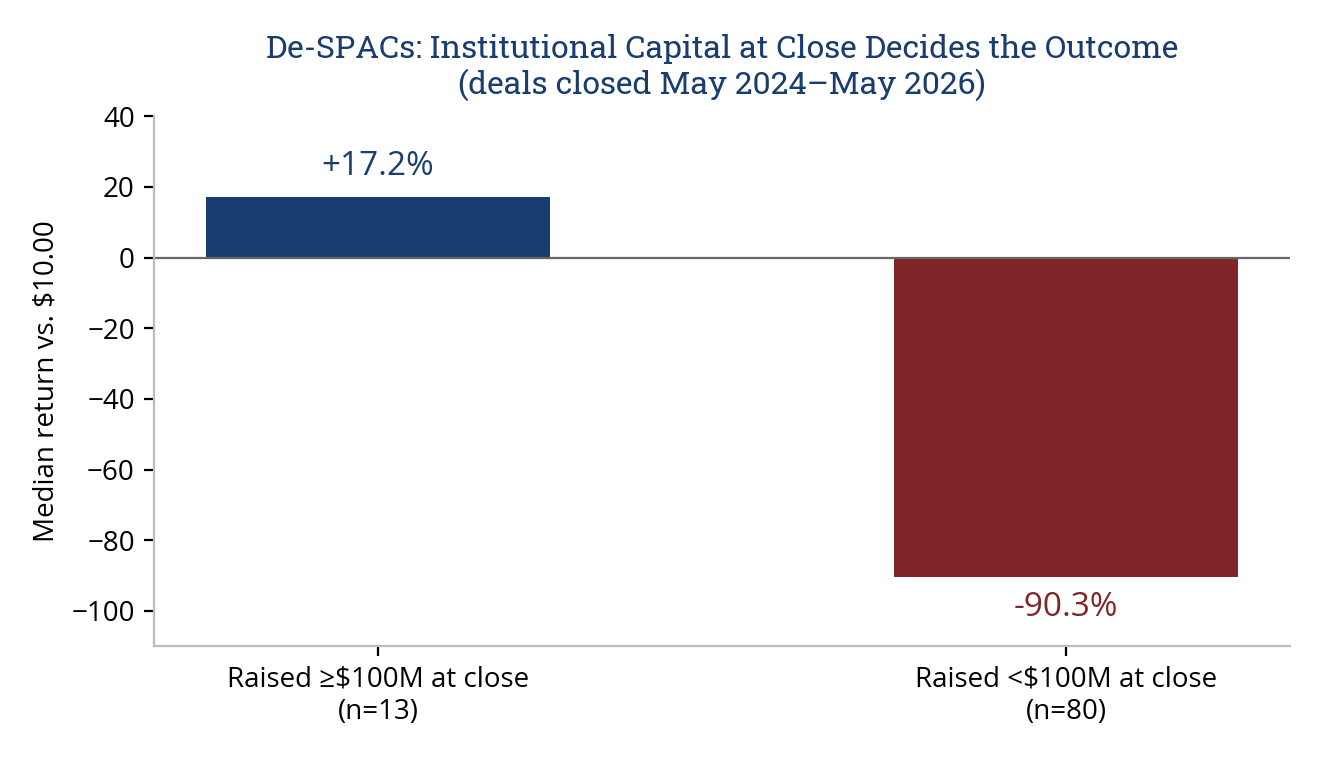
Figure 5. Median de-SPAC return vs. the $10.00 trust price by institutional capital raised at close (straight equity PIPE plus retained trust), deals closed May 2024–May 2026, n=93; p < 0.000001. Source: SPAC Insider; AUM Advisors analysis.
A de-SPAC that attracted $100 million or more of institutional capital at close posted a median return of +17.2% over the past two years; deals below that line posted −90.3%. The redemption vote tells the same story in real time: in H1 2026, every one of the three lowest-redemption deals trades above $10.00, while of the twelve deals that lost more than 90% of trust, exactly one does.
The practical translation for a board: the de-SPAC works when institutional investors, free to walk away, choose to fund your deal at size — and the PIPE process is where that verdict is delivered.
すべては交渉次第――そして、車両選びが結果の半分を決める
The standard objection to the de-SPAC — the 20% promote — is increasingly out of date.
Our July 2026 study of every H1 business combination agreement, Everything Is Negotiable, documented ten distinct promote structures in a single half year period: promotes cut to a flat percentage of the combined company, promotes vesting only above $12.00, promotes forfeited on formulas tied to trust retention, and in one case a promote that changed hands at $1.75 per founder share. Earnouts, lockup schedules, non-redemption agreements, and forward purchases give a well-advised target multiple levers to align sponsor, PIPE, and company incentives.
要点:対象企業が獲得できる条件は、選択するSPACや事前の準備状況に大きく左右される。 SPACとの契約に署名する前に、取締役会は、当該SPACのワラントおよび権利のオーバーハング(合併後も存続するもの)、引受会社の繰延報酬構造(クロージングの成否に応じた手数料)、信託の延長履歴と残高(期限のプレッシャーにさらされている経験豊富なSPACと、設立間もないSPACでは交渉の仕方が異なる)、およびスポンサーの過去の取引における実績を理解しておくべきである。 こうしたデューデリジェンスは地味ではあるが極めて重要であり、まさに経験豊富な独立系資本市場アドバイザーが、交渉の席に着く他のどの当事者とも利害が異なる対象企業のために行う業務そのものである。
パス III:直接上場
The direct listing solves a specific problem elegantly: a company that does not need to raise capital, but whose shareholders need liquidity and whose business benefits from a public currency, can list without dilution, without an underwriting discount, and without handing a first-day discount to allocated investors.
Spotifyをはじめとする十数社の大手有名企業が、2018年から2021年にかけてこの手法を採用し、長期的に優れた成果を上げました。
このガイドの読者の多くが抱く疑問は、それとは異なります。つまり、公開市場がまだ認識していないようなメリットを、この道筋は中堅・中小企業に何をもたらすのか、ということです。最近の記録は、この疑問に対して異例なほど明確な答えを示しています。
正当な主張
For the right company, the advantages of a direct listing are real:
不要な資金調達を行うことなく、証券取引所への上場と公的な通貨の地位を獲得すること;
ロックアップ期間の制約を受けず、購入初日から既存の保有者に対して流動性が確保されます;
引受割引はなく、割当を受けた投資家への初日譲渡も認められません;
前述の追加公募の仕組みを通じて、経験豊富な発行体として、後日資金を調達する選択肢。
また、独創的な投資銀行は、中小企業にとっても上場への道を開く仕組みを考案してきた。典型的な例としては、上場前の数ヶ月間にヘッジファンドや個人投資家向けに私募を行い、取引所が求める株主数と浮動株を確保した上で、上場を行うという手法だ。このルートを選ぶ企業は通常、これを「2段階の計画」と捉えている。すなわち、まずは上場を果たし、その後、公開市場価格で資金を調達するというものだ。
なぜこの流れが拡大しているのか――そして、取締役会がその理由を理解すべき理由
ダイレクト上場の件数は、過去最高の水準を記録している。2026年は8月末時点で18件に達しており、2025年の9件、2024年の3件を大きく上回っている。この増加の一因は、この仕組みが正当に認知され始めたことにある。
Part of it, candidly, is regulatory arbitrage. Beginning in 2025, Nasdaq substantially raised the bar for small IPOs: minimum public-offering proceeds requirements, a rule that only offering proceeds (not previously registered resale shares) count toward the public-float tests, heightened standards for certain cross-border issuers, and broader discretionary authority to deny listings. Those reforms attach to offerings — and a resale-only direct listing has no offering, so it is not subject to the same scrutiny of allocation sizes and the identities of new investors.
「正面玄関」を通れなくなった企業にとって、側門は最も抵抗の少ない道となっている。上場審査基準は依然として高い水準(200%)で適用されるが、私募市場が存在しない場合、その基準は企業自身が委託した独立した第三者による評価を基準として判断される。そして、取引所がこうした評価分析をどの程度厳格に審査するかは、この市場分野において、我々の見解では依然として未解決の問題である。
これは、掲示板側が問うべき質問だ。なぜなら、市場はすでにその答えについて独自の判断を下しているからだ。
記録が示すところによると
図6. 2026年年初来に完了し、始値および終値が確認されている全18件の米国ダイレクト上場案件について、初日の始値から終値までのリターンを示す。 中央値は−13.8%で、18件中11件が初値を下回って引けた。以前の草案では初値の確認が取れなかったため除外されていたQumulusAIが、今回+63.8%として追加された。出典:Jay Ritter、表13a(2026年8月27日更新)、取引所データ、AUM Advisors による分析。
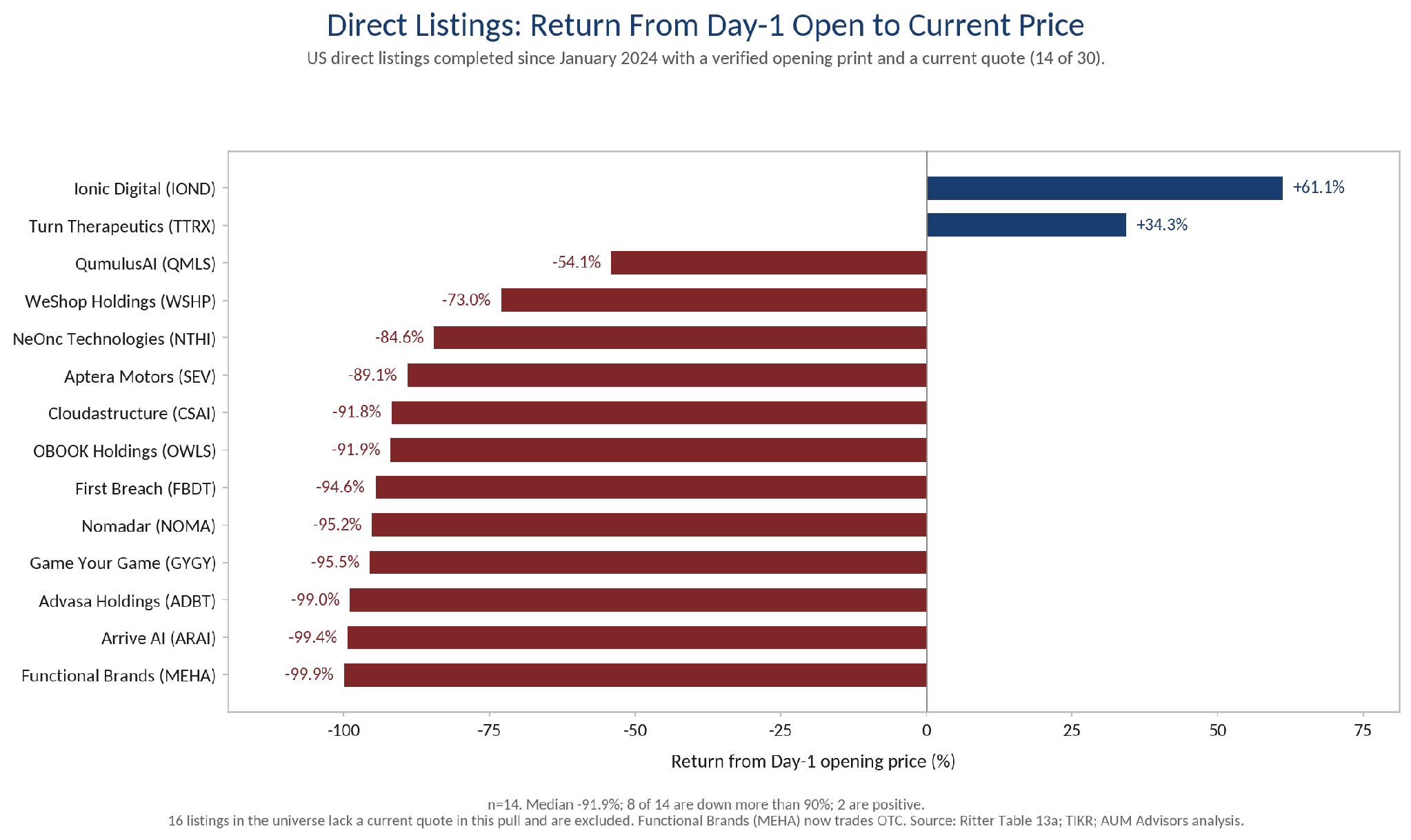
Of the 30 direct listings completed since January 2024 with verified trading data, 22 closed their first day below the opening price (median open-to-close: −25.6%). Measured to the current quote, the median direct listing in the sub-sample with live pricing has lost 91.9% of its opening value.
このグループのうち2銘柄が初値を上回って取引されています。Ionic Digitalは61%高、Turn Therapeuticsは34%高です。その理由を正確に把握しておく価値があります。なぜなら、Ionicはこのパターンの例外ではなく、まさにそのパターンを裏付ける証拠だからです。 Ionicは、上場前から大規模な既存株主基盤(すでに株式を保有していたCelsius Miningの債権者たち)、53ドルの基準価格で上場する前に完了した4億ドルの機関投資家向け資金調達、そして大手投資銀行をアドバイザーに迎えて上場しました。つまり、初値決定オークションの前に、すでに真の双方向市場が存在していたのです。同グループの他のすべての企業は、まだ存在しない市場を創出するよう初値決定オークションに求め、オークションはその期待に応えたのです。
The warning for boards considering the two-step plan — list now, raise later — follows directly: a listing that opens at an unrealistic valuation and collapses does not preserve the option to raise capital later; it poisons it. A company trading down 60–90% from its opening print faces financing alternatives that are dilutive at best and predatory at worst — discounted converts, variable-price instruments, equity lines — the very structures our de-SPAC research identifies as markers of subsequent failure.
A board choosing this path should want the same thing an IPO book provides: hard evidence, before listing day, that real investors will own the stock at the contemplated price. Where that evidence exists, the direct listing is efficient and honest. Where it does not, the opening auction will supply a verdict, publicly, and at the shareholders’ expense.
銀行:同じ金融機関でも、3つのまったく異なる職種
3つの構造すべてに同じ投資銀行が登場しますが、その役割、経済的側面、義務、および法的リスクは大きく異なるため、取締役会は、たまたま同じレターヘッドを共有しているに過ぎない3つの異なる取引相手として扱うべきです。これらの違いを理解することで、各選択肢が何をもたらし、何をもたらさないのかの多くが説明できます。
表2. 3つの構造における銀行の役割、経済的側面、実質的内容、および責任。出典:AUM Advisors 。
これに伴い、3つの実務上の示唆が導かれる。
First, the IPO discount is not merely a selling commission — it prices capital commitment, statutory liability, and aftermarket obligations that the other structures’ fees do not include; comparing headline fee percentages across paths without adjusting for what the fee buys is a category error.
Second, in a de-SPAC the target should map every bank’s incentives when weighing its advice: an advisor holding deferred compensation payable only on closing is not neutral on whether the deal closes. Certain highly qualified de-SPAC advisors and placement agents may not have any credible research team, whereas other banks may request a CMA agreement that primarily secures research support and aftermarket marketing. Only one investment bank that we are aware of guarantees research on its SPAC IPOs. Right of first refusal deals on SPAC IPOs can act as an embedded poison pill, deterring research and trading support from other investment banks during the first year of trading.
Third, in a direct listing the advisor’s name on the cover, however prominent, does not import underwriter diligence, capital, or support — the prospectus itself will say so, and boards should read that sentence as literally true.
意思決定の枠組み
3つの質問に正直に答えるだけで、選択肢を素早く絞り込むことができます。
Do you need primary capital within the next twelve months? If yes, the direct listing in its current form is effectively out, and the choice is IPO versus de-SPAC. If no — genuinely no — the direct listing enters the frame.
How much pricing certainty do you need, and what is it worth? If your plans genuinely depend on a valuation fixed months ahead — pending acquisitions, contractual triggers, a complex story that needs long-form marketing — the de-SPAC’s negotiated price is a real advantage worth paying for, provided the terms are negotiated against the current market described above. If pricing-day flexibility is tolerable, the IPO’s book-built price costs less than boards assume once the follow-on benefits are counted.
If your shares started trading tomorrow with no marketing, would a real two-sided market exist? Not "is our company well known" — is it known to public-market investors, with a demonstrated willingness to own the stock at your contemplated valuation. Ionic Digital could answer yes, which is why its direct listing worked. If the honest answer is no, the direct listing is not a shortcut, and the choice between IPO and de-SPAC turns on Questions 1 and 2 plus the size threshold: companies below the scale that attracts quality underwriters should weigh the de-SPAC-with-institutional-PIPE route against the micro-cap IPO’s documented record.
概要表
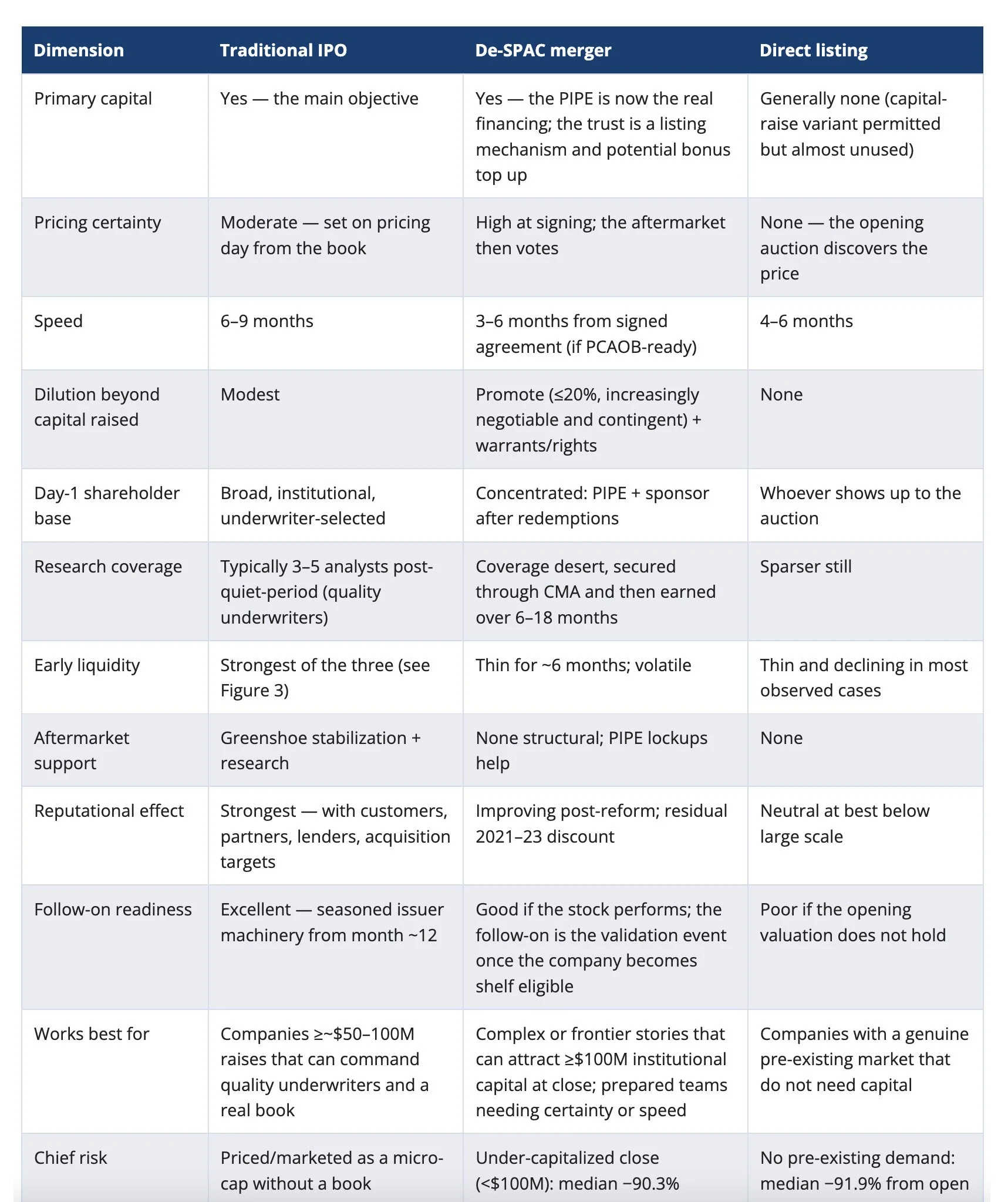
表3. 2024~2026年の実績に基づく3つの経路の概要。出典:Renaissance Capital、SPAC Insider、Jay Ritter、取引所データ、AUM Advisors の分析。
3つの道すべてに共通する要件は1つ
Whichever door a company chooses, the same public-company infrastructure must exist on Day 1: PCAOB-standard audits, internal controls on a SOX timeline, a board with qualified independent committees, disclosure policies and Reg FD training, a guidance framework designed to be beaten, and an investor-relations program built before — not after — the listing.
当社の調査報告書『De-SPAC成功のための5つの原則』では、この準備体制の構築について詳しく解説しています。このチェックリストは3つの経路すべてに等しく適用され、海外発行体は、目標上場日の12~18カ月前からその準備に着手すべきです。
国境を越えた側面
For international companies, the US listing decision carries additional considerations — and, increasingly, the record to inform them, because the current cycle is the most international in US market history. Foreign issuers accounted for 57% of 2025 US IPOs. Twenty of the 47 de-SPAC targets announced in H1 2026 — 43% — are headquartered outside the United States, across Europe, Asia-Pacific, Canada, and the Middle East; the H1 winners include Finnish, Singaporean, and Canadian technology companies making their US debuts. And in August 2026 a Tokyo-headquartered fintech completed the first Japanese direct listing on Nasdaq.
今や、あらゆる扉が国境を越える入り口となっている。しかし、これまでの経験から得られた教訓は、海外において特に強く当てはまる:
The size threshold bites harder. Smaller international issuers have defaulted for years to the micro-cap US IPO — the path with the weakest documented outcomes of any in this guide. An international board offered a $10 million US IPO should compare it, seriously, against a de-SPAC with a committed institutional PIPE — and against waiting to do a larger offering that will support real institutional interest.
The de-SPAC has quietly become an institutional-quality cross-border on-ramp. IQM Quantum Computers — the Finnish quantum hardware leader — closed its merger on July 1, 2026 with modest redemptions and an upsized $145 million PIPE that brought Finnish pension institution Ilmarinen alongside existing holders: a model of a European deep-technology company reaching US capital with institutional validation intact; as of early September, it trades modestly above its $10.00 baseline, at $10.80.
The direct listing’s cautionary record is disproportionately international. OBOOK Holdings (Taiwan) reached a $4.9 billion Day-1 valuation in October 2025 and trades 92% below its opening print, at $5.48. Advasa Holdings (Tokyo) opened at $12.00 on August 25, 2026, and closed its first day at $6.26 — down 48% — with home-market retail investors supplying much of the demand. It has since fallen to $0.13, more than 98% below its opening print. Cross-border issuers weighing this path face the additional reputational cost of a visible failure in their home market, where the next financing, the next customer, and the next hire are watching.
事例研究:実践における取り組み
Ionic Digital (IOND) | 成功したダイレクト上場 | 2026年7月 | 初値比+61%
Ionic Digital emerged from the Celsius Mining estate with a large creditor shareholder base that already owned the equity, added a $400 million institutional raise at the $53 reference price before listing, and engaged J.P. Morgan, Jefferies, and BTIG as advisors. The stock opened at $50, closed its first day at $62.90, and has since reached $80.56 — one of only two direct listings since January 2024 trading above its open. The lesson: the direct listing works when the two-sided market exists before the auction. Ionic built one first.
PayPay (PAYP) and DSC Holdings (DSC) | Two IPO markets, one year | 2026
The clearest illustration of the two-tier IPO market is two Asian issuers that listed on Nasdaq within three months of each other.
PayPay — SoftBank’s Japanese payments platform, profitable on $2.3 billion of revenue — priced its $880 million IPO on March 12 at $16.00, cutting below its $17–$20 range during one of the year’s most volatile weeks rather than postponing. The full package arrived on schedule: the stock opened 19% up and finished its first week +32%; ARK bought on Day 1; seven or more analysts initiated after the quiet period (Jefferies at Buy/$28, with Bank of America, Wolfe, Morgan Stanley, Mizuho, Citi, and Cantor following); and the ADSs trade millions of shares daily at a $10–11 billion capitalization. Six months on, the shares have recovered to $17.04, slightly above the $16.00 issue price — and the outcome is still a success on every objective in this guide: PayPay banked roughly $497 million of primary capital, its early holders are near whole, and it enters its first follow-on window with the coverage, ownership, and liquidity that were the point of the exercise.
PayPay (PAYP) and DSC Holdings (DSC) | Two IPO markets, one year | 2026
The clearest illustration of the two-tier IPO market is two Asian issuers that listed on Nasdaq within three months of each other.
PayPay — SoftBank’s Japanese payments platform, profitable on $2.3 billion of revenue — priced its $880 million IPO on March 12 at $16.00, cutting below its $17–$20 range during one of the year’s most volatile weeks rather than postponing. The full package arrived on schedule: the stock opened 19% up and finished its first week +32%; ARK bought on Day 1; seven or more analysts initiated after the quiet period (Jefferies at Buy/$28, with Bank of America, Wolfe, Morgan Stanley, Mizuho, Citi, and Cantor following); and the ADSs trade millions of shares daily at a $10–11 billion capitalization. Six months on, the shares have recovered to $17.04, slightly above the $16.00 issue price — and the outcome is still a success on every objective in this guide: PayPay banked roughly $497 million of primary capital, its early holders are near whole, and it enters its first follow-on window with the coverage, ownership, and liquidity that were the point of the exercise.
DSC Holdings — an Ant-backed Chinese used-car-software company with 90% share of its niche — raised $51 million on June 25 at $17.00 with Deutsche Bank and CICC on the cover. The names were blue-chip; the deal was not: three million ADSs, a float of roughly 6% of shares outstanding, and no book depth behind it. The stock opened below issue at $16.00, fell to $5.77 within four trading days, and sits near $8.00 — down more than 50% from the offer — with minimal coverage and thin volume. The lesson: the IPO’s advantages are features of scale and distribution, not of the legal form — and not even of the letterhead. A $51 million offering cannot buy the product an $880 million offering buys, whoever underwrites it. Buy the real product or choose a different door.
StablecoinX | 資本は必要条件だが、十分条件ではない | 2026年6月 | 80%のドローダウン後、10.00ドルに対して−21%
The largest PIPE of H1 2026 — $893 million from prominent digital-asset investors — belongs to a deal that closed with 99.6% of trust redeemed after a four-and-a-half-year SPAC life spanning eight extensions and traded down roughly 80% as of our July Scorecard; it has since recovered to $7.93, 21% below the $10.00 trust price. A nine-figure PIPE can fund a balance sheet; it cannot substitute for an operating story that gives public investors a reason to hold. The lesson: every quantitative threshold in this guide is necessary, and none is sufficient. The de-SPACs that work are businesses first and financings second.
結論:キャリアパスを企業に合わせる
米国での上場に向けた「最善の道」というものはありません。3つの異なる取引形態があり、それぞれ異なる取引相手、異なるコスト構造、そして上場後最初の1年間もそれぞれ異なります。また、これまでに1,100件以上の取引実績から、それぞれどのような企業が恩恵を受けているかが明らかになっています。
The IPO rewards scale and quality sponsorship with the fullest package the public markets offer.
The de-SPAC rewards preparation, negotiation, and the ability to attract committed institutional capital — and punishes their absence swiftly.
The direct listing rewards the rare company the market already knows how to price and teaches every other kind an expensive public lesson.
取締役会の役割は、パンフレットが最も魅力的な道を選ぶことではなく、どの説明が自社にふさわしいかを率直に見極め、そして選ばれた道のメリットを確実に実現できるよう、万全の準備を整えることにある。
その準備――対象企業のデューデリジェンス、条件交渉、投資家選定、上場に向けた体制整備、そして上場企業を流動性が高く、十分な市場価値があり、機関投資家が保有する公開企業へと変えるための広報戦略――こそが、どの道筋においても結果を左右する鍵となります。また、これは決して偶然ではありませんが、経験豊富な独立系アドバイザーがその存在価値を発揮する場面でもあります。
構造そのものが結果を決定づけるわけではありません。構造と企業の適合度こそが結果を左右するのです。そして、これまでの実績は、それぞれの道筋において、どのような適合が理想的であるかを如実に示しています。
Preparing for any of the three paths starts in the same place: our guide to IPO & Public Company Readiness.
Korean issuer? The corridor reopened in 2026 — see Korean Companies on Nasdaq.
概要AUM Advisors
AUM Advisors 当社は、国際的な発行体や、IPO、デ・SPAC、ダイレクト上場、クロスボーダー取引など、複雑な米国市場(資本市場 )における案件を対象に、IR 、資本市場 戦略、および投資家向け広報を専門とするシニア・アドバイザリー・ファームです。 当社の代表陣は、米国、日本、欧州、グレーターチャイナ、東南アジアにおいて、100件以上のIPO、SPAC、および追加公募取引に関して経営陣への助言を行ってきました。AUM Advisors は、そのビジネスモデルとガバナンスを全面的に支持できる企業のみに関与しています。選別性は制約ではなく、設計上の原則なのです。
Companion research: The Five Disciplines of De-SPAC Success (June 2026) · The De-SPAC Scorecard (quarterly) · Everything Is Negotiable: De-SPAC Deal Terms (July 2026). Contact: Crocker Coulson, Founder & CEO | crocker.coulson@aumadvisors.com | (646) 652-7185 | aumadvisors.com
データ出典、調査方法、および開示事項
IPO data: Renaissance Capital US IPO Market Annual Reviews (2024, 2025) and 2026 YTD statistics (IPOs and direct listings, market cap ≥$50mm, ex-SPACs and closed-end funds). Long-run first-day return data: Jay Ritter, University of Florida. 2026 YTD proceeds include one $75 billion listing accounting for more than half the total.
De-SPAC data: SPAC Insider universe; AUM Advisors analysis as published in the companion studies. Returns split-adjusted, measured against the $10.00 SPAC IPO price.
ダイレクト上場データ:2024年1月以降の米国の全ダイレクト上場案件に関するAUM Advisors のデータセット。ジェイ・リッターの表13a(2026年8月27日更新)と照合済み。初日価格は、公式の取引所終値と照合して検証済みで、株式分割調整済み。 現在の価格は、2024年および2025年に完了した上場については2026年9月10日時点、2026年に完了した上場については2026年9月14日時点のものです。対象となる上場件数は30件であり、そのうち14件は検証済みの初値とリアルタイムの現在の気配値の両方が存在します。現在の価格までのリターン統計値は、このサブサンプルに基づいて算出されています。
本ガイドは情報提供のみを目的としており、投資、法律、税務に関する助言、有価証券の販売の申し出、または購入の申し出の勧誘を構成するものではありません。過去の運用実績は、将来の結果を保証するものではありません。
米国での上場を検討していますか?
AUM Advisors counsels international management teams and boards on IPOs, de-SPAC mergers, direct listings, and the investor-relations build that turns a listing into a liquid, covered, institutionally owned public company.
Request a consultation with Crocker Coulson →
Companion research: The De-SPAC Scorecard · All AUM insights